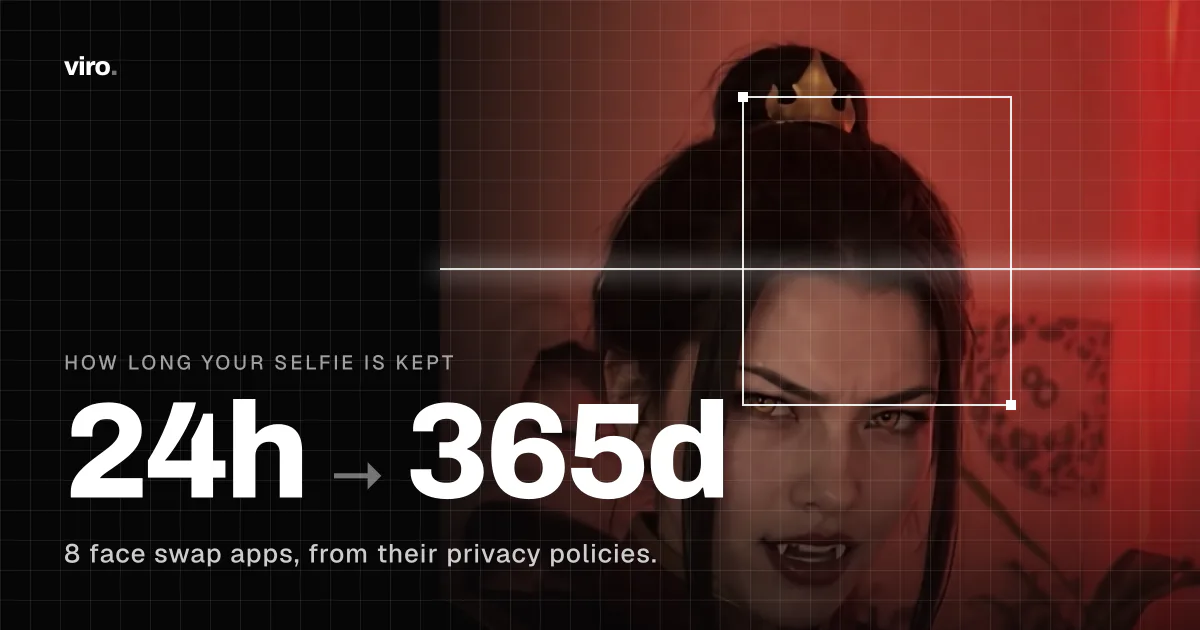
How long a face swap app keeps your selfie ranges from 24 hours to a full year. We read the privacy policies of 8 face swap video apps on October 28, 2026: Viro deletes your selfie within 24 hours, Reface keeps face data for 48 hours and uploads for up to 30 days, and Akool keeps uploaded content for 365 days unless you clear it. On training, Viggle may use free users’ uploads to train its models, while Magic Hour and Viro say they never do. Two apps, Remaker and Vidnoz, publish no retention period for uploads at all.
A face is about as personal as data gets, and most people upload without reading anything. You do not need to read whole policies. You need five answers, and this post has them for each app, with links to the exact pages.
The comparison
| App | How long uploads are kept | Used to train AI | How to delete |
|---|---|---|---|
| Viro | Selfie deleted within 24 hours | No | Delete your account from the account page |
| Reface | Face data 48 hours (30 days at most); uploads and results up to 30 days | Not stated | “Erase My Personal Data” in the app, or a request |
| Viggle | Face data from uploads not stored; uploads stay in your library until you delete them; free-plan files 7 days | Free plan: may be; paid plans: not without written consent | Delete uploads in your library; requests by email |
| Magic Hour | As long as reasonably needed; deleted accounts restorable for 14 days | No, on any plan | Delete projects in the app, or request account deletion |
| Akool | Uploaded content 365 days unless you clear it | Face data only with explicit consent | Clear uploads yourself, or request deletion by email |
| DeepSwap | FAQ: 30 days from the last swap; policy: face photos deleted once the video is made | Not mentioned | Erase pages for uploads, creations and faces |
| Vidnoz | As long as needed; within 72 hours of a deletion request | Not mentioned | Remove data in your account; account deletion by email |
| Remaker | Not published | Not published | Not described in the policy |
“Not mentioned” means the policy does not talk about training at all. That is not the same as a promise not to train. DeepSwap’s two pages contradict each other on how long uploads are kept, so we list both.
1. How long is my photo kept?
This is the most important question. A photo that is deleted right after use cannot leak later, cannot be handed over in a dispute and cannot be reused under a new policy.
Look for a number of hours or days, not a phrase. “As long as necessary” and “as long as reasonably needed” let the company decide. Three apps in the table give real numbers: Viro (24 hours), Reface (48 hours for face data, 30 days for uploads) and Akool (365 days). DeepSwap gives two different ones.
On Viro: uploaded photos, and any biometric information derived from them, are permanently deleted within 24 hours of upload.
2. Is my photo used to train AI models?
Some apps use uploads to improve their models. Once your face is in a training set, deleting your account does not take it back out.
Read this part carefully, because the answer can depend on what you pay. Viggle’s policy says images uploaded on the free plan, and the videos made from them, may be used for training, while content made on a paid plan is not used without written consent. Akool asks for explicit consent before using face data. Magic Hour says it never trains on uploads, prompts or outputs, on any plan.
On Viro: no. Your photo is used only to make the videos you asked for, on every plan, including the free video.
3. Who else gets my photo?
Making the video usually happens on an AI provider’s servers, not the app’s own. Ask who that is and what they may do with it, and whether the app sells or shares data for advertising.
On Viro: the photo goes only to the AI provider that makes the video, under a contract that limits its use to that task. It is never sold, and Viro does not share personal information for advertising.
4. What else is in the file?
Phone photos carry metadata, often including where the photo was taken. An app that keeps the original file keeps that too.
On Viro: photos are re-encoded on upload, which removes metadata such as location. They are stored privately and encrypted in transit.
5. Can I delete everything?
You should be able to leave and take your data with you, without writing to a support address and waiting.
Most apps here let you delete uploads yourself, but full account deletion often goes through email: Vidnoz, Akool, DeepSwap and Viggle all route at least part of it through a request. Reface has an in-app “Erase My Personal Data” option. Magic Hour keeps deleted accounts restorable for 14 days before removing them for good.
On Viro: you can delete your account from your account page at any time, and you can ask for a copy of your data.
Free plans and privacy
Free plans are where the trade-offs hide. In the apps we checked:
- Viggle’s free plan is the only one where the policy says uploads may be used for training.
- A free face swap from a site you have never heard of is the riskiest option. Before you upload, check that it has a policy that answers the five questions below. More on that in free face swap video with no watermark.
If you pay for one app, pay for the one whose answers you like. Price per clip is in how much an AI face swap video costs.
Rules that protect other people
Your privacy is half of it. The other half is the people in your photos:
- Upload only your own face, or the face of someone who agreed to it.
- Photos of anyone under 18 are not allowed on Viro.
- Do not use results to deceive anyone or to suggest something happened when it did not.
A quick checklist for any app
Before you upload, find these in the app’s privacy policy:
- A retention period in hours or days for uploads and for face data.
- A plain yes or no on training, and whether it differs between free and paid.
- Who processes the photo, and whether data is sold or shared for ads.
- Whether metadata such as location is removed.
- A way to delete your account yourself.
If you cannot find them, or the answer to number 2 is yes for the plan you are on, think twice about uploading your face. Viro’s answers are all in its privacy policy.
Sources
All read on October 28, 2026.
- Viro: privacy policy
- Reface: privacy policy
- Viggle: privacy policy, pricing
- Magic Hour: privacy policy
- Akool: privacy policy, biometric data policy
- DeepSwap: privacy policy, FAQ
- Vidnoz: privacy policy
- Remaker: privacy and cookies policy
FAQ
How long do face swap apps keep my photos?
It depends on the app. Viro deletes your selfie within 24 hours, Reface keeps face data 48 hours and uploads up to 30 days, and Akool keeps uploaded content 365 days unless you clear it. Several apps publish no period at all.
Do face swap apps use my photos to train AI?
Some do. Viggle may use free users' uploads and results for training, but not content made on a paid plan. Magic Hour and Viro say they never use uploads for training. Akool uses face data for training only with explicit consent.
Does Viro use my photos to train AI?
No. Your selfie is used only to make the videos you asked for, and it is deleted within 24 hours of upload.
Can I delete my account and photos?
On Viro, yes, at any time from your account page, and your videos and history go with it. Most apps let you delete uploads or ask for deletion by email; their routes are in the table above.